

Many people claim that AI is going to kill product management. I think they’re wrong.
The feature factory is already killing us.
Eight years ago, John Cutler coined the term feature factory, which essentially means shipping features without knowing why. That should be part of the past, but it’s still crushing our souls in 2025.
We’ve got to defeat it before it burns us out.
I see 3 steps to defeat this bloody enemy:
Understand which feature factory elements are part of your day
Prioritize actions to defeat the enemy
Evaluate the results and decide what to do
Now, I’ll tell you one thing: Defeating the feature factory is anything but easy. It requires a lot of courage and a pinch of audacity. If you’ve got that running in your veins, I will give you seven bold moves to put the enemy down. Shall we?
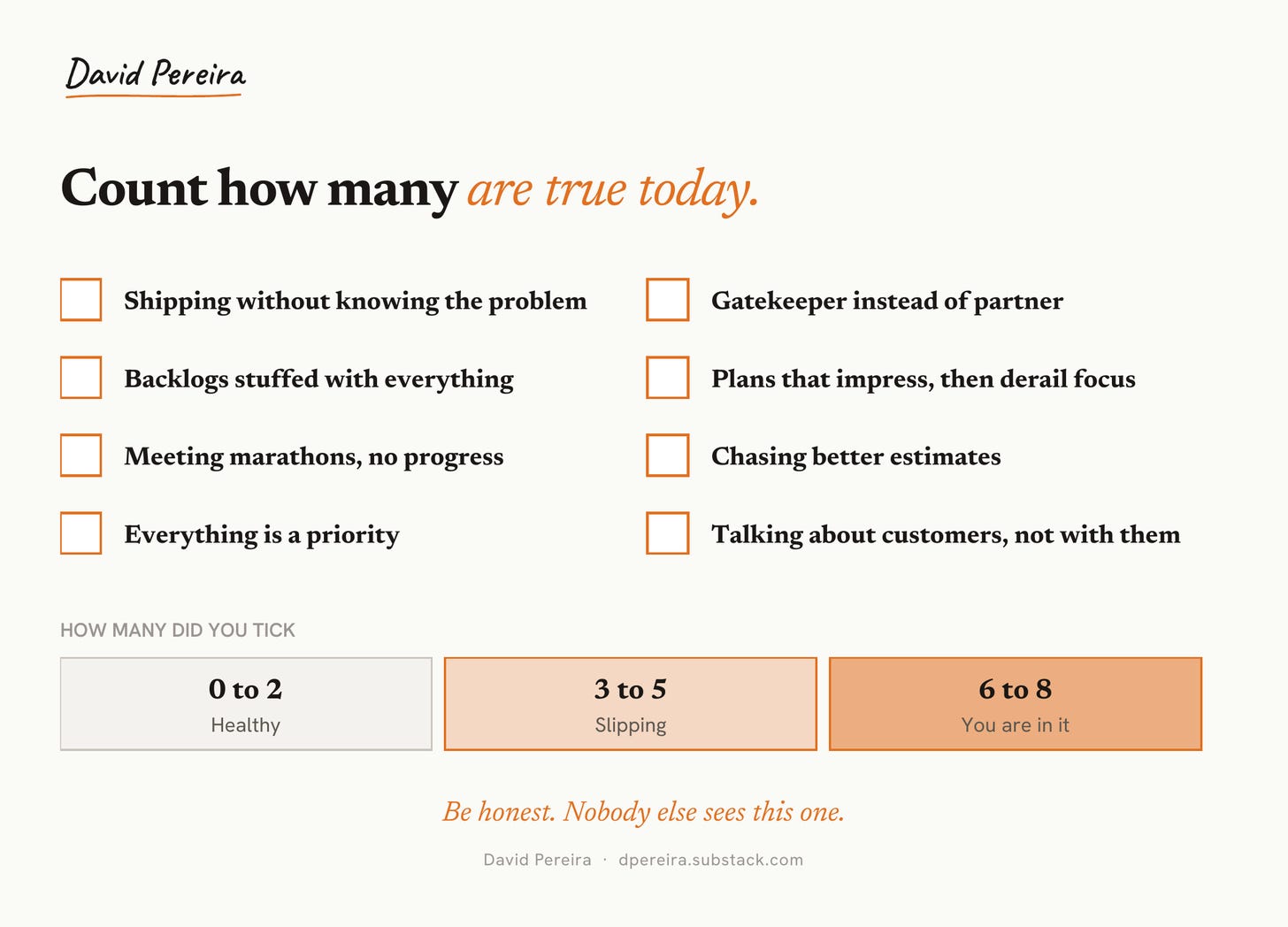
How do you know you’re part of the feature factory?
We need to have an honest conversation about the product game.
How present are the following items in your daily life?
1. Shipping features without knowing the problem they solve
2. Bloated backlogs stuffed with everything
3. Meeting marathons that burn time but not progress
4. Juggling topics because everything’s a priority
5. Acting as gatekeepers instead of partners
6. Building plans that impress management but derail focus
7. Chasing better estimates instead of embracing uncertainty
8. Talking about customers instead of with them
The more present the above items are in your work, the more the feature factory is knocking you out. It hurts to recognize that. You may even disagree with me if that’s how you work now. And I understand you because that is what I thought for years.
You’re busy with the wrong things when you work in a feature factory mode. Yet, you know what to do. You have way more work than you can deliver, even if you use AI.
When trapped in feature factory:
People want better specs instead of more context
Engineers long for clear acceptance criteria instead of problem understanding
Leads seek better estimation techniques instead of focusing on time investment
Product folks wonder how to structure your better backlog instead of figuring out how to run experiments faster
Focus on solutions to implement over solving problems
In short, it’s easy to trap ourselves even further once deep in the feature factory.
How do we land in a feature factory situation?
Predictability and certainty are elements that everybody wants.
Management wants to know what gets done and by when. They also want to ensure that software engineers are working full steam, with no space to breathe; they must be busy, and you should feed the beast.
Everybody wants to be in control, but can we?
Maarten Dalmijn wrote a lot about the fog of speculation in his book, Driving Value with Sprint Goals. Many think that more time spent planning gives us more certainty and clarity, but it just adds more speculation and illusion.
The more precise the plan, the more it fools you.
Our fear of the unknown traps us.
The feature factory ensures we deliver more stuff but doesn’t guarantee value creation. It sucks to be part of this situation because purpose is absent and we don’t know how our work contributes to something bigger.
Now, let me give you the 7 bold moves to put the feature factory down:
Help everyone see the elephant
Define the one thing that matters
Cut the noise and apply radical focus
Partner with the business instead of pleasing them
Talk to customers, not about them
Test assumptions before they test you
Stop estimating, start investing
Let’s understand each of them and how you can apply them.
Before we crash the annoying feature factory, I have an offer for you: a transformation from feature factory to value maximizer. This is my best material, and you will learn why most teams don’t go beyond the feature factory and how you can move away from it.
1. Help everyone see the elephant
Everybody knows something stinks when you’re in a feature factory. Yet, nobody talks about it. If you want to change it, start by making the elephant visible.
Now comes the trick: tell one of the following to managers if you want to be ignored:
We’re trapped in a feature factory
We’re not measuring outcome
We’re missing out on product discovery practices
Management doesn’t care about the above. They care about money!
Do the following instead:
Create a report of all features shipped over the last 18 months
Percentage of customers using each feature
Frequency of use of each of them
Value created for the business & customers
It will be hard to make that happen, but if you can do the first two items, you can already make a point. Around 50% of features may be used by just 5% (or less) of your customers. With such a report in your hands, you can ask: “Should we keep investing in features almost nobody cares about?”
If you can estimate each feature’s cost, you can shock management even more. Then, you can suggest doing things differently, which paves the way for the next moves.
2. Define the one thing that matters
Another common lie: we’re good at multitasking.
The more you juggle, the lower your performance becomes. Yet, I wish performance were the only problem. We have limited cognitive power. Keep adding things to your plate if you want your creativity to evaporate along with your potential.
It requires guts to define what matters, but that’s necessary if you want to achieve the results most teams only dream about.
The problem is that everyone talks in plural: objectives, goals, priorities. You will benefit if you dare to use the singular, not the plural.
What’s the one thing you should be doing right now? Define that and give your full attention to it to get it done without distractions.
Follow this principle: Stop starting. Start Finishing.
3. Cut the noise and apply radical focus
Your ability to say no enables you to focus on what matters. Yet, it’s easy to say no but hard to keep the relationship sustainable.
It’s hard to drive value when everyone and everything distracts you. To focus, you need to regain your time. Here are some practices:
Turn off all your notifications. You should define where your attention goes, not your apps.
Create blocks to read emails, answer messages, and do bulk tasks. Do all at once, and then wait for the next block.
Share with people how you’re working so they have clear expectations.
The above will give you the chance to focus. Now, you need to ensure you focus on what matters. People will bombard you with requests labeled as urgent and important. It’s not always true, but it’s often a way of stealing your time.
Only say yes to what:
Contributes to your current product strategy
Connects to your current priority (singular)
Helps you accelerate value creation
Some stakeholders won’t have answers to the above, which is fine. You can help them get the answers, but you shouldn’t say yes without clarity.
Yes = responsibility
No = decision
4. Partner with the business instead of pleasing them
Business stakeholders aren’t your customers. Yet, they are not your enemies.
You become a service provider when you treat business as customers. And everybody loses when you treat them as your enemies.
Strong partnerships are necessary to win the product game. Work closely with business stakeholders so you become partners in crime. Product teams cannot create everything alone. You need marketing, legal, finance, accounting, operations, customer service, and more to create an outstanding offering. And you can only do that when:
You’re all on the same page
Share the same objective
Work as partners
I know the above is often above what product teams can control or influence, but you can raise concerns about the current collaboration model. I usually find a solution when I get the critical business people in the same room. You need to get everyone to collaborate, meaning that sometimes you act as a facilitator so you can build bridges and establish a partnership relationship style.
It does take time to reach a solid partnership level, yet that’s essential to keep you out of the feature factory nightmare.
5. Talk to customers, not about them
How often do you talk to customers?
The longer it takes for you to talk to customers, the more dangerous your ideas become.
It shocks me that many teams talk about customers and not to them. Reasons vary:
Salespeople block contact with customers
B2B customers are hard to reach
Customers don’t show up in interview calls
The above is very accurate. Yet, you should be relentless and not give up.
Establish a routine for talking to your customers weekly or biweekly. If you cannot build a customer pool, use services like Usertesting.
For B2B clients, create a customer advisory board with your Ideal Customer Profile or Early Customer Profile. Five participants will do. If you give them the chance, you may be surprised at how much customers want to be part of something.
For B2C, create a customer pool you can reach frequently. You may need to define a reward for customers, which should be fine because the cost of not talking to customers often enough will be features nobody cares about.
6. Test assumptions before they test you
Untested assumptions are the mother of f*ck-ups.
We assume something happens. Then, that doesn’t happen, and we’re all crying afterward because we land in a disastrous situation.
Before you develop any solution, ask what you’re assuming to happen:
How do you know customers want it?
How can you ensure they will understand how to use it?
How will you collect business value?
How do you know you can deliver it?
Identify your assumptions, prioritize the critical ones, and run experiments. Critical assumptions are those that, when proven false, make your idea worthless.
You can use AI to accelerate assumption testing. Many tools will help you create interactive prototypes in seconds:
My take: The longer it takes to develop something, the more you should test your assumptions.
Some things are quick to develop, and you can take the risk of building useless stuff because the investment is low, but be careful with high investments.
“Avoid big failures, or you’re dead.
Embrace small failures, or you’re dead.”
- Alexander Osterwalder, Strategyzer CEO
7. Stop estimating, start investing
Estimations lead to more unnecessary conversations than you imagine.
First, estimations take considerable time, yet they’re plain wrong. No matter how you picture it, estimations will be inaccurate, but stakeholders will nail you once you miss a “promised” date.
Why should you bother with estimations if they always get you in trouble?
I used to recommend #NoEstimates as an alternative, which I still find valuable. You ask one question: “Does this fit our dev cycle?” If it doesn’t, you break it down until it does. It accelerates estimation, but it misses one part. It sets teams to focus on scope and output.
Over the last year, I found it more valuable to ask a different question: What can we do in [time investment]?
I like that because product people should see everything as an investment opportunity. You need to understand your team’s cost and how much investment makes sense and work backward. You can ask the team what’s achievable in a week. Then, the team needs to reflect on what’s possible and decide what matters and what to cut.
As a product person, you decide whether to invest further based on results. I recommend making gradual investments instead of upfront ones. Since using this strategy, I have seen software engineers move from feature builders to value maximizers. A different question will lead to a different attitude.
Final Thoughts
The feature factory sucks. Yet, letting it win without a fight sucks even more.
I won’t lie. It’s hard to defeat the soul-crushing feature factory, but defeating it bit by bit is rewarding. You need hope to keep moving on and courage to act when everybody neglects.
What do you say?
If you want to learn what most product people get wrong, check out this self-paced course. It will help you become a more valuable product professional.
I love and share your passion on helping product teams succeed. There is one statement that caught my attention: Management doesn't care about trapped teams; they only care about money.
In most cases, Management does care about outcomes. And they must care about money. Like you advise teams to think investments. And we've all built features we really wanted to be successful, and failed.
What I'm trying to say here is: It's hard to build products (and features) that are being used and do earn money. Management is not your enemy here. It is trying to navigate the risks and increase the odds of winning. Just like PMs do. Let's be passionate about building the best product together.
Awesome post, but it leaves a semi-sweet taste in my mouth—kind of like my YiaYia Maria, who shared her brilliant recipe for Baklava but always left out the secret ingredient that gave it soul.
That’s what AI in product management feels like in this story.
The missing spice.
The real enabler behind the bold moves you outlined.
Some spices that feel missing when it comes to AI-driven PM:
- Rapid user simulation
- Real-time hypothesis testing
- Data-driven backlog triage
- Conversational discovery at scale
- Context-aware delivery support
- Generative strategy scaffolding
Yeah, I’ve got a post on it—but that’s not the point.
The point is: **if we want out of the feature factory, we need to level up our AI game.**
Because you don’t beat the factory by working harder.
You beat it by working braver, smarter ... and way more outcome-obsessed.
Happy to trade thoughts here, or over on my Substack.