

In 2021, I wrote about the 7 signs of weak product management. Recently, I decided to revise it. Why? Sometimes we get so deep into new solutions that we forget what they were for.
Let me take you back to my first role as a lead. I was a head of product, and I remember my continuous fight against the corporate firewall. I wanted the team empowered with problems worth solving, and I wanted them to figure out the solutions on their own. Overcoming that firewall was tremendously challenging. Sometimes I won, not always. But I kept moving forward regardless.
Here’s the part I never shared publicly, I wrote that list with the 7 poor product management signs for me. I knew I was sliding into some of those signs, and I wanted them clear in my mind so I’d catch myself and step back.
The world around the list changed completely. In 2021, we spent our energy debating Kanban vs Scrum vs Scrumban, and the more progressive among us would bring up Shape Up. Today, nobody cares about any of that. The question became “how much AI are you using?” I think it’s the wrong question, but it’s the one that gets you the shiny new job or the promotion.
Five years later, are the seven signs still relevant?
Funny enough, I think they’re more present today than in 2021, for one simple reason. You’re a prompt away from getting something out. It may be hollow, but it will look like progress, and you will probably like it because of the dopamine effect.
Let’s go through them, one by one.
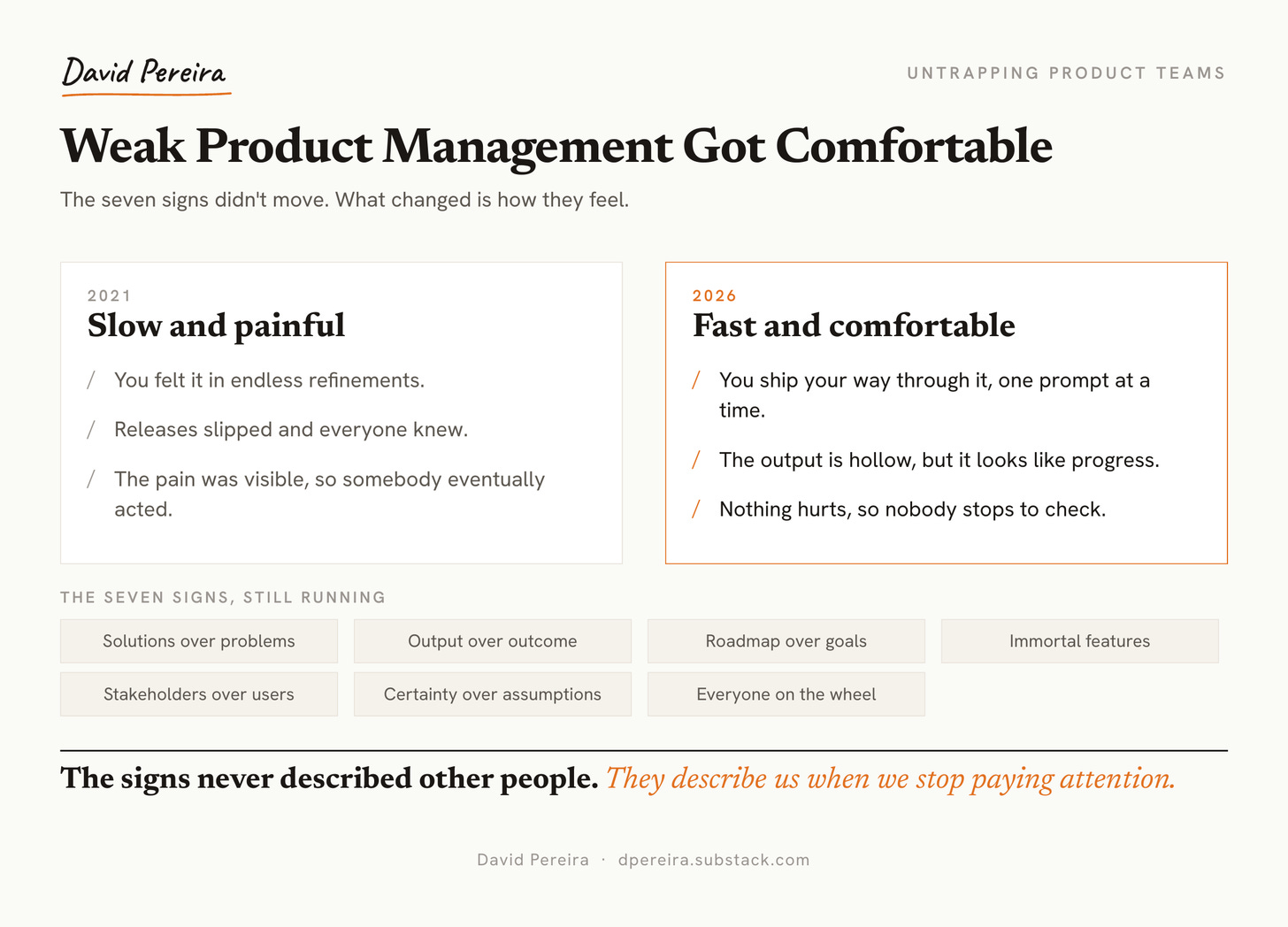
1. Solutions over Problems
In 2021, roadmaps, backlogs, and refinements were all about solutions, and the problem behind them was ignored.
In 2026, shipping got so easy that people build their own tools over a weekend. And yet, they still struggle to name the problem they’re solving. We got dramatically better at producing solutions and not one bit better at understanding problems. Sometimes I ask people to show me the problem statements, and they roll their eyes as if I’m completely outdated. Maybe I’m missing something, what do you think?
2. Output over Outcome
Should I still say something about it?
I’m kind of tiered of this debate, but it’s hard to ignore it. We insist in starting every conversation with the output we want instead of the outcome we’re seeking. Five years, hundreds of talks, one book, and the first question in most meetings is still “what should we build next?” instead of “what impact do we want to create?”
The tools changed and our behaviour (or lack of it) remains the same old one.
3. Roadmap over Goals
In 2021, roadmaps were feature lists with deadlines, and the goal was absent.
In 2026, the feature list has a new default item. Recently, I was at a conference with 300 people in the room, and I asked: who has AI on the roadmap? I believe 9 out of 10 raised their hands. Then I said, keep your hand up if you believe that’s the right thing to do right now. At least half of them lowered their hands.
Half the room is building something they don’t believe in, because it’s on the roadmap. How do we keep doing things we know aren’t the things we should be working on? I know, people want to keep their jobs, so staying quiet is sometimes the best option. When a situation like this happens all the time, I don’t blame people, but the systems. Goals are still the key to everything, and they’re still nowhere present.
4. Immortal Features
No matter where I am, I ask the same question: when was the last time you killed a feature? Retired it, sunset it, even just hid it. I’ve asked this simple question in 30 countries since 2021, and I barely ever get a brave person saying “I f*cking did it!”
We put stuff out, don’t measure the result, and complicate our products. Why? Because we know when we’re doing something wrong, yet the pressure from higher up gets us to do it anyway.
And here’s the 2026 twist: we now add features faster than ever to products we never clean up. The immortal features are bursting like popcorn, and that’s anything but good.
5. Stakeholders’ Wishes over User Feedback
This one got more complicated than ever.
Your stakeholders can now ship stuff too, or show up with a working prototype. “I already built it, can your team just polish it?” is a conversation I never had in 2021.
Meanwhile, talking to customers somehow happens less. We talk to synthetic users and believe in them. I’m not against synthetic users. But limiting yourself to one data point was bad in 2021, and it’s still bad now, no matter how articulate that data point is.
Remember NIHITO: Nothing Important Happens In The Office. It didn’t stop being true because the office got a chatbot.
6. Certainty over Assumptions
In 2021, overconfidence made companies build without validating. In 2026, LLMs confirm your assumptions faster than ever.
The other day, I asked ChatGPT to help me craft a product strategy to sell sausages on the moon, because I believe it’s a blue ocean. Here’s what I got:
“We believe people will live on the Moon. When they do, they will want more than survival. They will want food that feels familiar. Our strategy is to become the company that sells sausages on the Moon by building the technology, partnerships and brand on Earth first.”
It also told me I’m not starting a business, I’m starting a revolution. A brilliant idea of selling sausage in the moon.
I’ve written several times now, and I believe you’re tired of it, but I will repeat: Critical thinking is yours, not AI. Check your assumptions against reality, not a cheerleader. Being fair here - Not all LLMs are the same, some more critical (Claude), and some more positive (ChatGPT). The point is you’re accountable for results, do your job mindfully.
7. Two Drivers: Product Owner and Product Manager
This is the one that changed the most over the last five years. It didn’t fully disappear, but it transformed.
In 2021, my position was one bus, one driver. Two people splitting “find the right thing” and “build the thing right” was a recipe for confusion.
In 2026, the roles blurred. PMs code and design. Designers and engineers make product decisions and ship value. Everyone drives. In a few stricter, more rigid organizations, I still see the PM vs PO confusion, but it’s gradually disappearing.
So did we solve it? Not quite. We traded two drivers for a bus where everyone has a hand on the wheel. Blurred roles can be a gift, but only when one thing stays sharp: someone must own the direction end to end. The titles matter less than ever. The ownership matters more than ever.
Direction will still beat speed. Someone needs to answer where are we going, and why’s that the place we should be going? Then, we can craft our way towards it collaboratively.
The One Thing That Changed
Reading the old article again, I realized the signs didn’t change, but the cost of ignoring them did.
In 2021, weak product management was slow and painful. You felt it in endless refinements and delayed releases. In 2026, weak product management is fast and comfortable. You ship your way through it, one prompt at a time, and it all looks like progress.
That’s why I needed this list five years ago, and it’s why I need it more today.
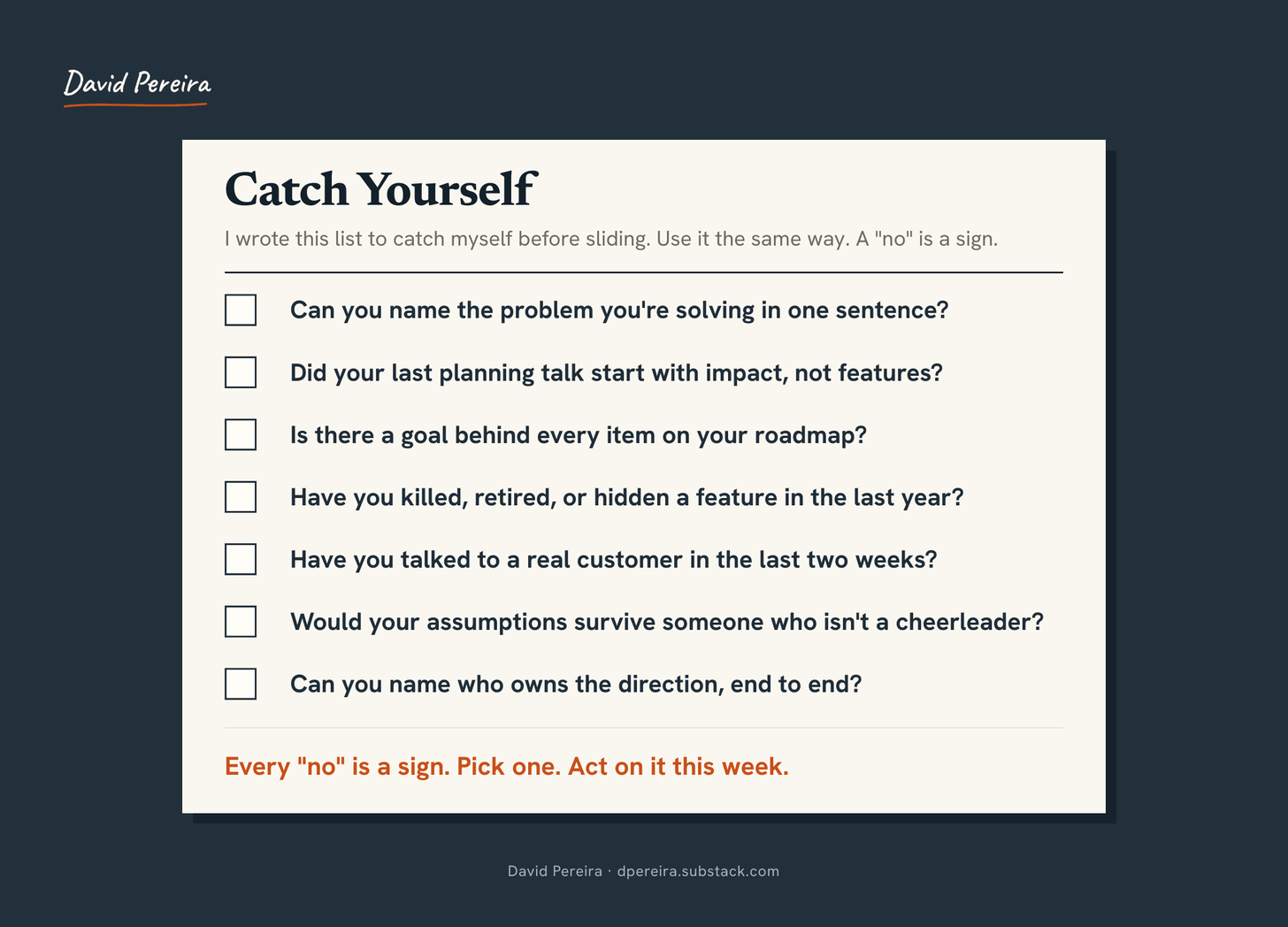
I wrote this list in 2021 to catch myself before sliding into weak product management. Five years, one book, and thirty countries later, I still read it for the same reason.
The signs never described other people. They described what we all become when we stop paying attention.
What are the signs you’re finding in your scenario right now? Once you identify them, you can take action, one at a time.
Talk soon,
David
100X PM Coach
I too am interested in the Moon sausage trade, but my ChatGPT told me:
"Yes, but the first strategic problem is that you may have confused a blue ocean with an absence of water."
It then built me a strategy around identifying as the Lunar food brand before Lunar food is a thing. So that when it becomes a thing, I am the default.
Ended with:
"the most important strategic warning:
'Blue oceans contain customers. Empty oceans merely contain no competitors.'
Your job for the first several years is therefore not really selling sausages on the Moon.
It's building a profitable Earth business whose ridiculous, memorable North Star is putting a sausage on the Moon."
Honestly, I'm sold.