

Four years ago, I was pissed. I knew I wasn’t doing product management, but I couldn’t name what I was doing. Eventually, the term found me: bullshit management. I wrote exactly what I felt, published it, and moved on. Barely did I know what was about to happen.
That single article got over 1 million reads combined across LinkedIn, Substack, Medium, and my website. I ended up speaking about it at conferences in 12 countries. For a long time, I asked myself why this one traveled so far.
The answer is uncomfortable. People were tired of doing bullshit management, but they didn’t have a name for it. I gave this name and people embraced it.
Back then, I defined it like this:
Bullshit management is the art of doing things that bring no value but drain your energy. The more bullshit you handle, the less value you create.
Four years later, I went back to the original article and read it word by word. I wanted to know: did we escape from bullshit management, or did AI amplified it?
Here’s what I found. Nothing on that list disappeared. Every single item either survived, mutated, or got an upgrade. Let me walk you through all ten.
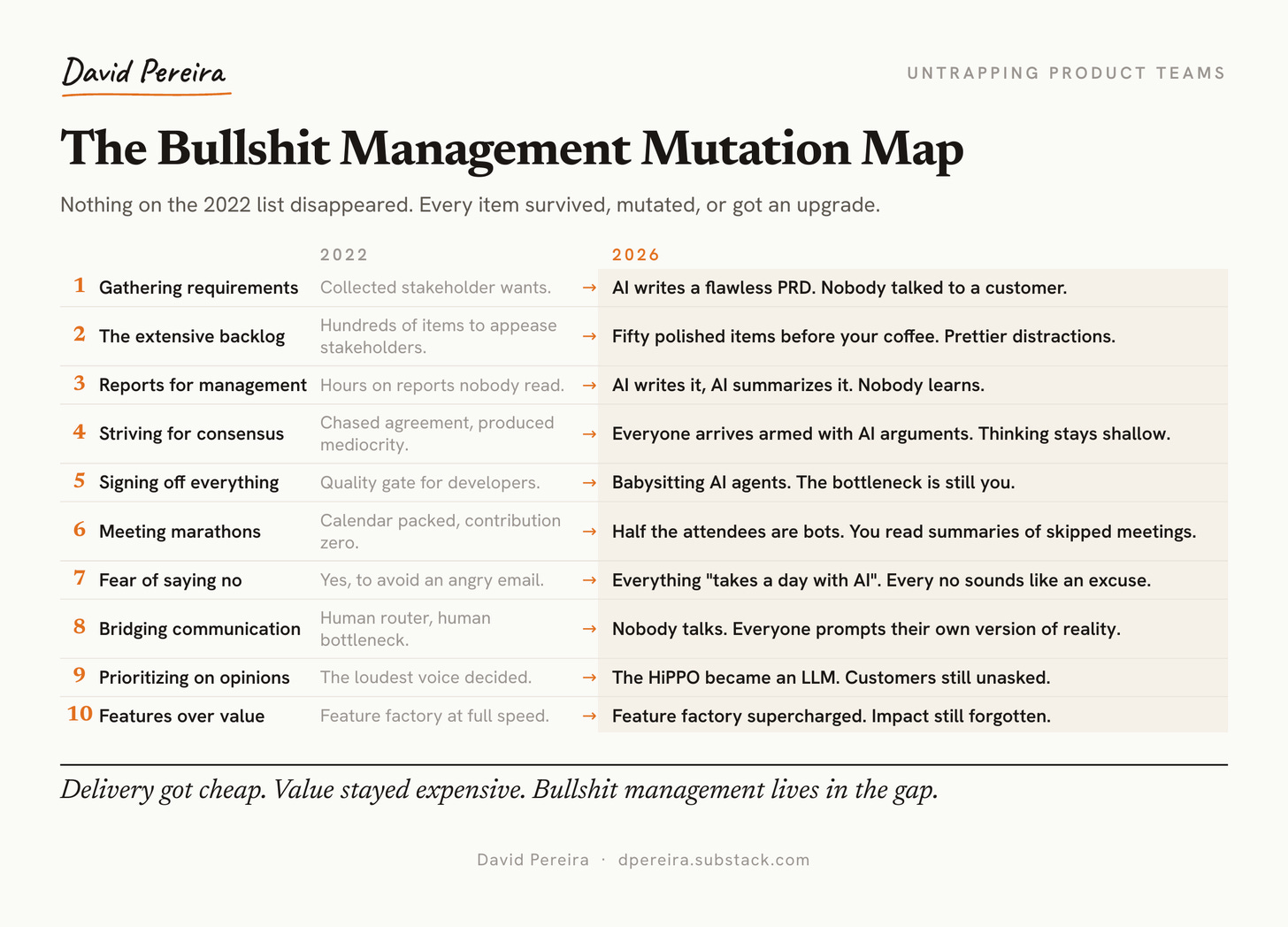
The BS Management Mutation Map
1. Gathering requirements
2022 → You collected stakeholder wants and shipped them without knowing real customer needs.
2026 → You don’t even collect anymore. You paste a Slack thread, a Zoom transcript from stakeholder alignment, or just drop the unstructured business “requirements” into LLMs and get a flawless PRD back. User stories, acceptance criteria, edge cases, all of it. Yet, most probably nobody has talked to a customer. The document might look perfect but the REAL understanding is absent.
2. The extensive backlog
2022 → You kept hundreds (thousands in some cases) of items just to tell stakeholders their requests were registered.
2026 → Still true for some teams, thankfully not all. But here’s the unfortunate mutation: AI can write fifty well-crafted backlog items before you finish your coffee. The backlog didn’t improve with that, but the distractions got more beautiful. They are shiny and dangerous because we assume we know more than we actually do.
3. Performance reports for management
2022 → You spent hours preparing reports nobody ever read. Velocity was a classic one that got you discussing something that led nowhere.
2026 → You generate the status update with Ai, and your manager summarizes it with AI. Two machines exchange information while nobody learns anything. We automated the fake progress and called it productivity. I really wish I didn’t have to write that, but reality often sucks.
4. Striving for consensus
2022 → You chased agreement from every stakeholder and produced mediocrity. When everyone got tired of discussing, you agreed on moving on with the most nonsense and boring product option.
2026 → Every stakeholder now arrives armed with AI-generated arguments for their must-have feature. Ask AI to defend any opinion and it will, confidently, with sources (not always trustworthy). We amplified hollow discussions that look rich in the beginning, but our true knowledge is shallow because we didn’t develop the thinking.
5. Signing off everything the team delivers
2022 → You were the quality gate for your developers, reviewing every single ticket. Thumbs up or thumbs down depending on your taste.
2026 → You’re the quality gate for machine output. AI-written specs, AI-written summaries, AI-written everything, all waiting for your review. You stopped micromanaging people and started babysitting AI agents. The bottleneck is still you. Some get out of this by “cloning” themselves and letting AI review for them.
6. Attending meetings to avoid pissing off stakeholders
2022 → Your calendar was packed with meetings where you contributed nothing. I called that meeting marathons. The art of talking more about work than doing the work itself.
2026 → The meetings survived and multiplied. Now half the attendees are notetaker bots, and you read AI summaries of the meetings you skipped. We found a way to not attend meetings and still waste time on them. And yet, we reach no alignment and keep scheduling more meetings to discuss stuff for the sake of it.
7. Fear of saying no
2022 → You said yes to pointless requests because your boss might get an email. And because you got tired of arguments and sometimes just wanted to get some progress.
2026 → Saying no got harder. When building was expensive, a no had a business case behind it. Now everything “takes a day with AI”, so every no sounds like an excuse. The cheaper delivery gets, the more courage a no requires. Your struggle now is direction and customer activation. People have a limit to the changes they can consume, so you better choose carefully.
8. Bridging communication
2022 → You were a human router between business and tech. A bad pattern, and I said so. Quickly you became the bottleneck, and held people back from improving their communication skills.
2026 → This one didn’t mutate, but it collapsed. Often, communication simply doesn’t happen anymore. Everyone prompts their own assistant, builds their own version of reality, and works in their own silo. The bridge was dysfunctional, now we traveled back to the past and amplified silos. I call it regression, not evolution.
9. Prioritizing based on opinions
2022 → The loudest voice in the room decided what got built.
2026 → We replaced the HiPPO with LLMs. Teams ask AI what to prioritize instead of asking customers what hurts. Different means, same nonsense. Today, we talk less than ever to real customers, this is extremely sad.
10. Delivering features over maximizing value
2022 → The feature factory was at full speed. Success meant delivering on time and accelerating speed. Outcomes were hardly part of conversations.
2026 → The feature factory now is supercharged, though I wish we’d not be talking about it anymore. Today is weird to say the least, people are shipping everything because they can, while renouncing critical thinking. The metric didn’t change, speed still dominates talks from teams to execs. Still hard to believe, but real impact remains forgotten. People get hired because they know AI, then people get fired because they didn’t make an impact. Interesting, right?
And the old sign about explaining failures instead of learning from them? I don’t even know what to say about this one. Teams ship more and measure less, and officially nothing fails. More stuff out doesn’t mean more value, but we persist on this thing. New tools, same traps.
What Actually Died
One thing died in these four years, and almost nobody noticed how vital that was.
The delivery constraint died. Delivery used to be bloody expensive, and that protected us, though we didn’t see it that way. It forced us to choose and ask why before building. It gave every no an economic argument. Today, that’s gone. And that’s an accidental problem.
Delivery got cheap while value stayed expensive. And bullshit management lives in the gap between them. That’s the part we seem to have forgotten.
The hard part of product management was never managing backlogs or writing beautiful documents. Those were means to ends. The hard part was knowing what’s worth doing. That part didn’t get any easier. On the contrary, it got harder, because now it’s messed up with a mountain of vibe-coded things nobody needs.
What Emerged
Two new types of bullshit didn’t exist four years ago, now they’re everywhere.
Shiny sh*t. AI can now produce a strategy, a roadmap, or an idea deck that looks absolutely solid. Polished structure, confident language, impressive vocabulary. And no thinking behind any of it. I see these constantly in my work with teams, and they never survive three simple questions:
Which options did you consider?
What gives you confidence?
Why now?
Ask these three and watch what happens. Beating around the bush means you’re looking at bullshit that shines like gold and stinks more than you imagine.
Tool obsession. Everyone is hunting for the next orchestration setup, the next agent workflow, the perfect stack. The stack changes three times a quarter while the thinking doesn’t change once. The tool was never your problem. It won’t be your solution either. I keep reading the “Ultimate Guide to AI” over the last year, ChatGPT was the winner, then Gemini, now Claude, tomorrow, who knows? And honestly, who cares? The winners are the ones with the strongest critical thinking.
The Supercharged Bullshit Management
Here’s what scares me most about this era.
Back then, bullshit management drained your energy. That exhaustion was your warning signal. You felt drained at the end of the day, and the feeling told you something was wrong. I believe that pain is why a million people read my 2022 article full of typos and reshared it thousands of times.
Today, AI absorbs the drain. Bullshit management doesn’t feel like bullshit anymore, but somehow it feels like progress. You shipped, you documented, you presented, you summarized. You’re moving somewhere, but is it where you should be?
Bullshit management used to exhaust you. Now it flatters you. That’s what makes it more dangerous, not less.
You’re in charge of your direction, not AI.
Your Way Out
I won’t leave you powerless. I never do.
This week, turn the three questions on your own work first. Take your current strategy, your roadmap, or the thing you’re about to ship, and answer honestly: Which options did I consider? What gives me confidence? And why now?
If you lack reasonable answers, you know what to do. You know exactly where to put your energy. Not into producing more shiny stuff, but into thinking sharper.
In my view the product people who will matter in this era aren’t the ones shipping faster. They’re the ones who evolved their judgment while everyone else outsourced theirs.
Building with judgment is exactly what the 100X Product Builder Masterclass is about. On September 8th and 10th, we go from raw idea to product the right way around: strategy first, assumptions next, then building. AI does the heavy lifting, you do the thinking. If the three questions made you squirm, that’s where you practice.
Four years ago, people were tired of doing bullshit management. Today, most don’t even notice they’re doing it.
Delivery got cheap while value stayed expensive. Bullshit management lives in the gap, killing your impact altogether.
Talk soon,
David
100xPM Coach
Very well put! It made me laugh multiple times by how on point it is.
Many of us have attempted to change this for decades. We were successful in some orgs but never lasted. I think it is the human condition as we are seeing play out globally with our political leaders and billionaires.
I think AI will help us move the needle, Agile did a little. The US DoD did a paper on Age Bullshit. No one really wants to change if it means doing something radically different or doing something that will eventually be replaced or modernized.
Let’s see what this paradigm shift will bring.