
Cutting the Noise.
What can you stop doing now?

Working in product & tech is complex, and you cannot simplify it by adding stuff. The more things you add, the more complex your game becomes. And if you keep reading the beautiful LinkedIn posts, it won’t take long for you to feel left behind. Then, without reflecting, you complicate your work.
Do you really want that?
I believe you want to simplify what others complicate. But the question is, how can you do that?
You definitely don’t simplify your workflow with 67 Claude Skills, 13 Agents, and 19 new AI tools. Maybe some truly help you, not all.
I’ll share my approach with you that unlocked my professional growth, which I call adding by subtracting. Yes, it’s about removing what you’re just doing because you’re used to it, but you no longer need it.
It’s easy to get into a routine that “serves” us, and we keep doing it daily, weekly, monthly, and yearly. We don’t even know we’re in a loop, and we don’t notice how much it gets in the way of progress.
The Human Enemies in Disguise
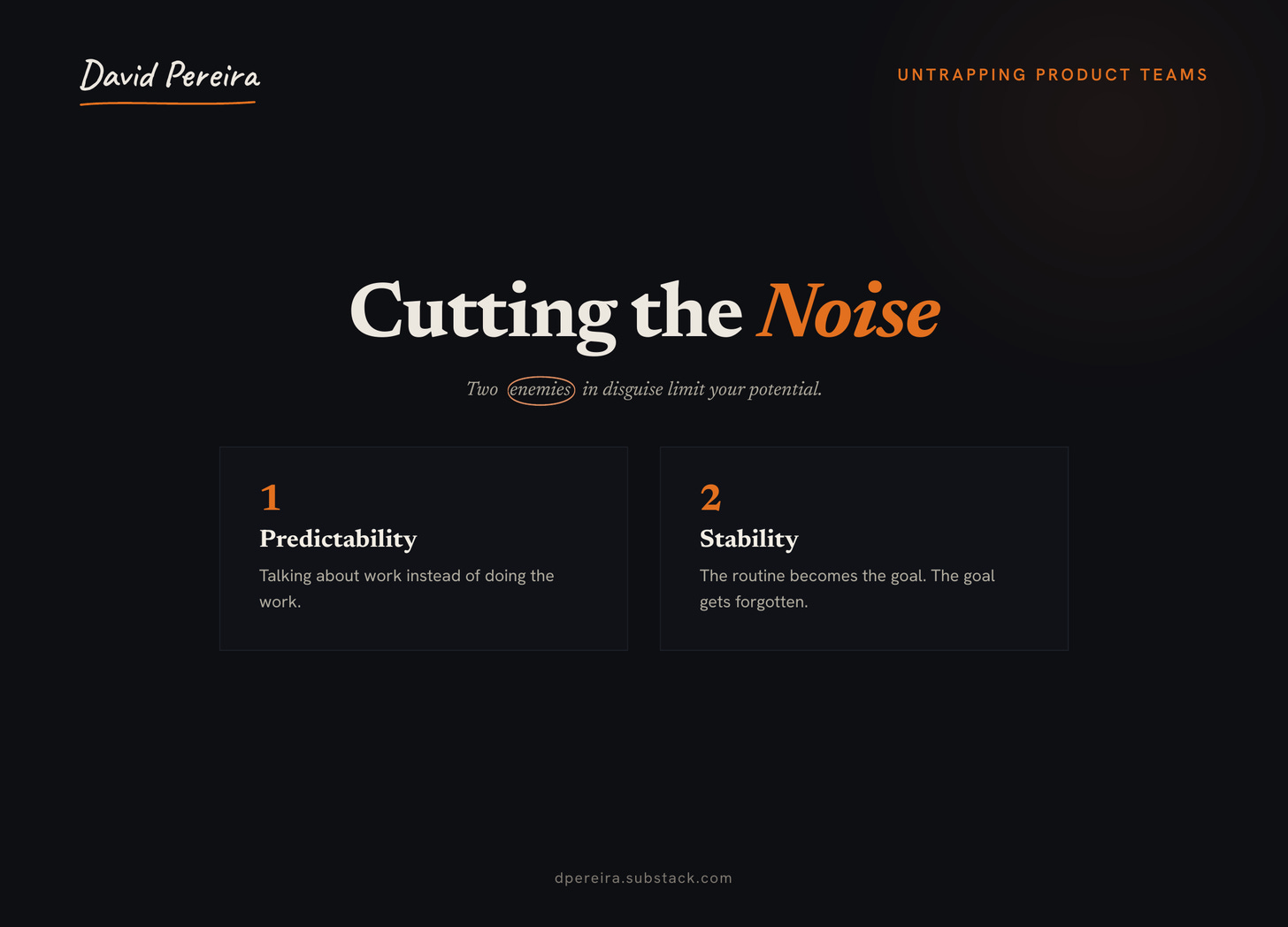
We love two things that often limit our potential, but give us a sense of control and security. Can you already imagine what I’m talking about?
As humans, we don’t like surprises, especially the ones where we feel a lack of control. What do we do to avoid unexpected events? We aim for predictability. This is our first enemy, who at first looks like a friend.
Predictability gets us talking more about work than doing the work itself. It kills real progress, but injects a feeling of moving somewhere by planning, discussing, and having meetings.
If predictability kills progress, who do you think the second enemy is?
Reflect on what else we love as humans. Routine. We like stable ways of doing things, which makes sense. But it has an unwanted side effect. Eventually the routine becomes the goal, and you no longer remember the original goal.
Stability is the second enemy. The more you long for stability, the more processes you create. Then people do what the processes allow them, not what they could be doing. It becomes your innovation killer.
The excessive focus on predictability and stability will massively reduce your potential. That’s when adding by subtracting helps you avoid such tricky situations.
Becoming the Noise Remover
Reviving your 5-year-old mind is the best way to stop what doesn’t serve you anymore. Start asking why to things you do routinely. Do that long enough and you will find so many things that don’t serve you any longer.
Throughout my career, I became the 5-year-old and I removed so much stuff, which not everyone liked at first, but later collaboration improved a lot. Here are a few examples:
Deleted 800+ backlog items at once. Two emails received later. We finally talked about what truly mattered.
Killed DoR (Definition of Ready). A few complaints initially, and long-lasting improvement in collaboration.
Removed “PM Approval” from our workflow. People called me reckless at first. Later, teams’ accountability increased, and our results became better.
Stopped all recurring meetings (yes, all). This one was more painful at first because of the chaos. But within a few weeks, we started working on what matters instead of what was in the calendar.
Simplified the tool stack. In all the places I’ve been, people were using more tools than needed, which complicated the workflow. By removing tools, we focused on collaboration instead of getting tools aligned.
One important aspect. When you choose to become the noise remover, people will try talking you out of it. You’ll be seen as a disruptive person, and they want you to fit in, and add to the predictability and stability game. The interesting thing is that people come up with hypothetical scenarios, fears, and risks, but nothing based on reality. Let me share the first story in more detail with you, and a lesson I learned later.
I noticed our backlog was too extensive, outdated, and distracting. I wanted to delete everything and restart fresh. I shared that first with the CPO, who was completely against it because we had “much” knowledge there we couldn’t lose. Then, I got reflective. And later I talked to the tech lead, who was also against it because of our “tech” tickets. Curiously, the items were years old. In my mind, if we hadn’t touched it for years, it couldn’t be relevant.
I listened to the concerns and yet I decided to delete all items untouched for six months. People called me nuts, reckless, and I thought maybe I did something outrageous. But then, nobody really cared within days, weeks, and months. And I learned one thing: whatever matters will come back to you with the right context, at the right moment. That’s when I started using my favorite principle:
“Backlog Items Age Like Milk, Not Wine.”
The lesson from this story is important. The moment you choose to be different, you cannot search for confirmation because you won’t find it. You have to understand why you’re doing what you’re doing, and then be bold and act when everyone hides behind processes and routines. Yes, it’s hard, but hard is often easier in the long term.
Here’s a list for you to consider. You don’t have to do everything, take it as inspiration for what you could do differently. Try one at a time, or figure out yours, and just do it.
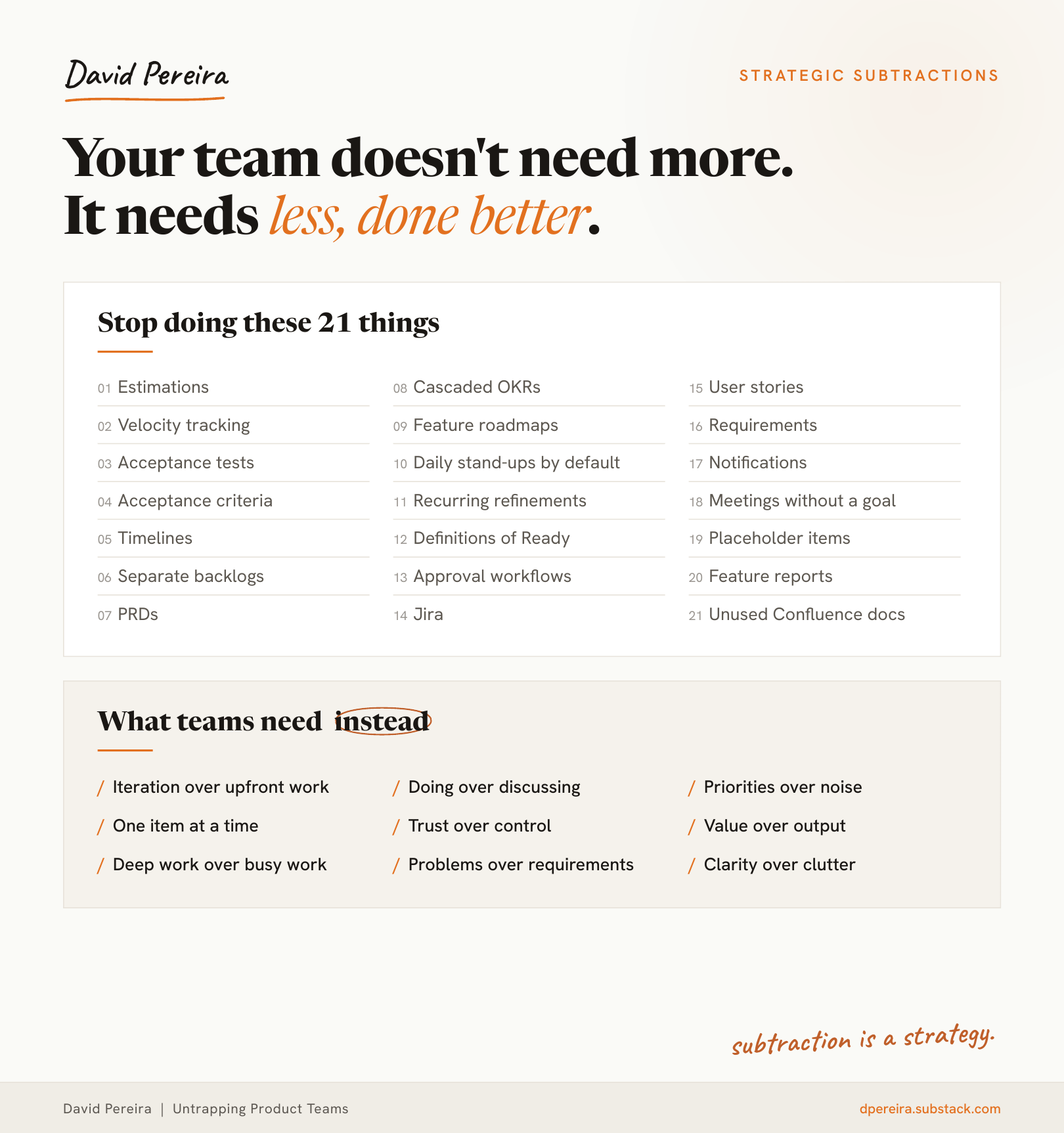
Stop Complicating, Start Simplifying
Continuing with my vision of simplifying what others complicate, I follow another principle: Never add before subtracting. It’s simple to understand, hard to apply because it requires us to renounce something.
Let me take a personal example. I never buy new clothes before getting rid of old ones. First, I identify some items that I could donate, sell, or simply throw away. And then, after that, I can get new clothes, not before.
I apply the same principle to product, collaboration, and life continuously. A few more examples:
Limit the number of meetings you take a week. Need more? Remove something.
Limit the number of backlog items. You cannot exceed it, you must delete something.
Tools you use to craft products. Cap the number. Learn what fits your needs best, remove the rest.
Now, I won’t bullshit you saying I’m perfect because I’m far from that. I break my principles sometimes, but I don’t trash talk myself. I try learning what led to that, and what I could do differently next time.
Adding by subtracting will help you have more mental space, which enables you to make better decisions, which makes you stand out.
Now, my challenge for you this week.
Look at your routine, and reflect on one thing that doesn’t serve you anymore. What about stopping that? See what happens, monitor the result, and evolve.
Only when the old goes away does the new find its space.
How can you move from idea to value with an approach that cuts the noise?
Today, everyone longs for shortcuts. People are renouncing thinking, and betting high on AI Agents doing it right for them. I believe those with a structured approach that supports collaboration, transparency, and critical thinking will outperform others.
Building today is easy, but shipping value is another story.
If you want to learn how to move from idea to value with a structure that helps you make the critical decisions gradually, I have something for you.
Next month, I’m running a two-day workshop to help you transform this.
You can join us here. Limited spots. First come, first served.
Talk soon.
David Pereira