

Making decisions that make no sense is one of my specialties. When I look back at my trajectory, I said yes to so many opportunities I was clearly unprepared for. Every time that happened, people around me shared their concerns, called me crazy, and oftentimes stupid. I believe they were right, but how can you grow in life if you’re not up to some madness?
One of my favorite Brazilian musicians, Raul Seixas, once wrote about the meaning of madness. Translating it word by word would be something like this:
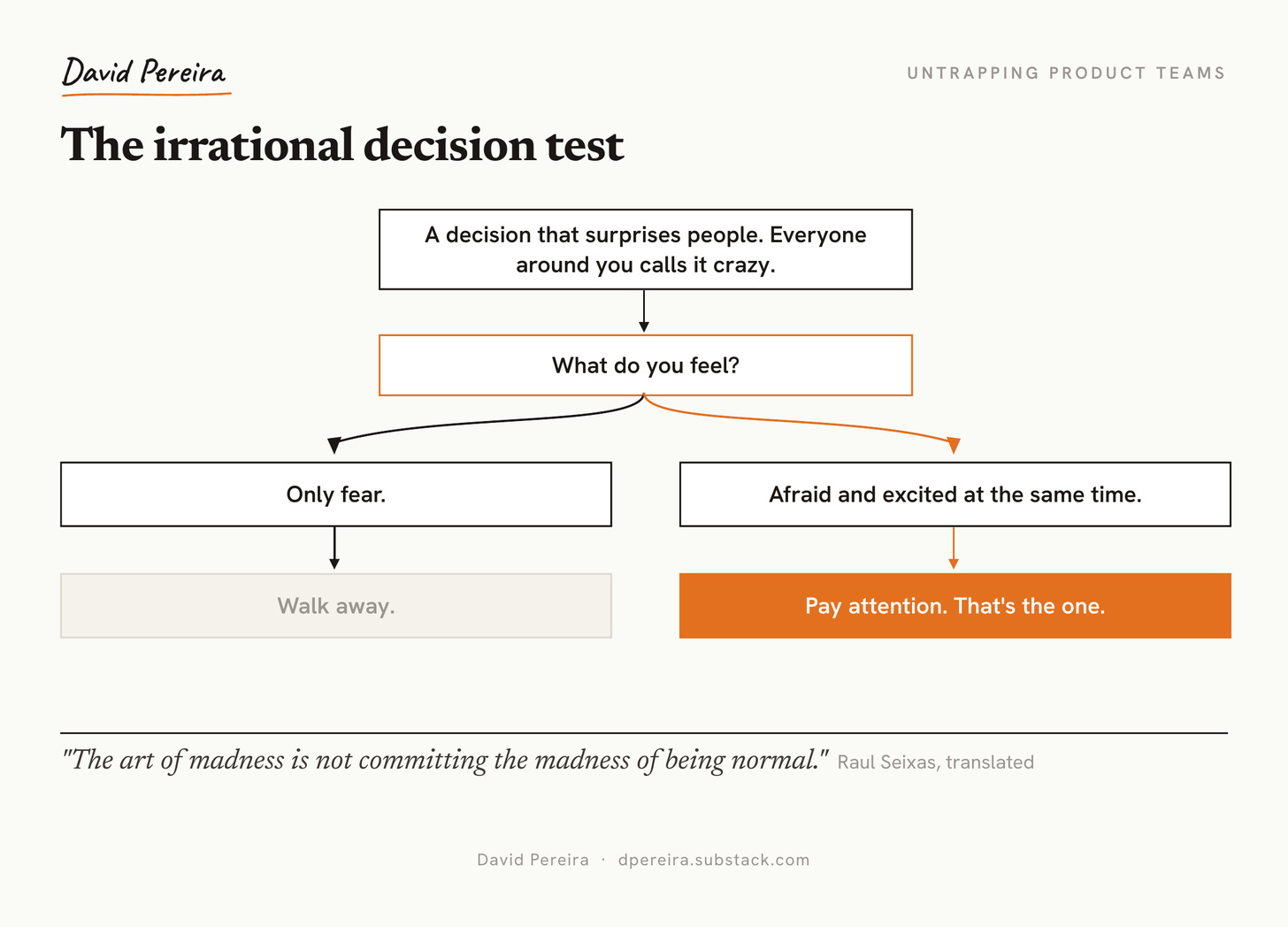
“The art of madness is not committing the madness of being normal.”
Being normal means fitting in. You do what’s accepted. You do what others expect you to do. It’s a comfortable life at the cost of growth. But is it wrong? You decide that. Some people love stability more than anything else, while others like me love the adrenaline feeling, the challenge of figuring stuff out because you clearly got a problem to solve bigger than your current capabilities.
Let me share a few stories with you about making decisions.
Acceptable Decisions Keep You Where You Are
The interesting thing about making decisions is that most people around you already decided for you what a good decision looks like. The only thing left for you is to execute the obvious.
As a product person, it’s expected that you deliver on the roadmap, write backlog items that software engineers can work on without talking to you (or agents now). Attend ALL meetings that you’re invited to even when you know it makes no sense. Understand the nuances of your product better than anybody else, stay on top of what the competition is doing. And the list keeps going.
If you decide to act like that as many product folks do, you will likely be seen as reliable, and a good employee. When things are fine, your position is safe. But when things aren’t solid anymore, you’re a candidate to get a promotion to the market.
Why does that happen?
Executing tasks is easy. Achieving results is a completely different game. Even today when AI supercharges product folks, companies are still looking too much at outputs. Yet, this means other people can do what you do.
That’s not bad at first glance, but it does limit where you can get. For many people that’s fine, they stay with their jobs, get paid, and then enjoy their free time doing whatever they please. The challenge happens when they have to start doing something else because the company went belly up.
I knew someone who went from software engineering to head of product in just a couple of years. He did everything that he was told incredibly well. He was reliable and trustworthy, and with time he earned his promotions. However, the company wasn’t doing well for years, and then the tragic fate took place. The company went bankrupt, and he had 3 months to find a job or return to his country. Guess what happened?
He applied to many product jobs, and got rejected by every single company. Eventually he gave up and took a job as a software engineer to keep the visa. He had hoped to grow into a product leader again, but that never happened. But why? After talking with him, he shared that his approach had always been doing well what’s expected from him. And that’s precisely the problem, you need to surprise people to go further. You need to surprise yourself.
Irrational Decisions Unlock Your Growth
Have you ever had the situation where you’re about to make a decision but then everyone around you knows best what you should do? They criticise you, and try getting you to walk away from this decision. Up to this point, it’s normal. The question is what will you do about it?
First, let me define what I mean. An irrational decision is something that surprises people, and somehow you’re afraid and excited at the same time. If you only feel the fear, walk away. If you feel both, pay attention.
Let me share another story with you, in this case, one from me.
Last year I was the CEO of a startup. I had a decent 6-figure salary in Germany, a company car, premium insurances, and loads of perks. By any measure, I was well compensated. But I felt something wasn’t the way it should be anymore.
I signed up for the challenge of being the CEO because I wanted to outgrow myself. I knew I wasn’t ready for it, but I tried. And somehow we achieved great things. We got an outstanding team together. I remember approaching 100+ people on LinkedIn daily to get the right people on board. Then I called as many potential customers as you can imagine to learn about them. Within a few months, we progressed, and then started signing customers.
Then at the end of 2024, I had a board meeting that drained my whole energy and motivation. They wanted me to create a strict three-year plan that should be unchangeable, and the team had to commit to it. If you read one or another post from me, you’d understand that’s completely contrary to what I believe in. I did try getting them to step back, but they didn’t care about it, and in a power fight, I lost.
In my gut, I knew what I had to do. I had to walk away and do something else. At the same time, I had the dilemma that 60% of the company were people I hired, and I didn’t want to let them down. Yet, I refused to embark on a journey I didn’t believe in at all. I knew I could no longer lead them this way. I confided that to a few people, most of them said, “That’s the job, and you’re paid for that. Keep doing it. If I were you I’d swallow my pride and do whatever. The money is good.” The only thing is that they weren’t me.
When I decided to quit, almost every person I know told me how stupid I was. How could I walk away from the prestigious position, great package, and benefits? How could I change the certain for the unknown?
My wife was and is the main supporter of my irrational decisions. When I told her what I was about to do, she said, “I support you. You will figure out what to do next. These guys are draining you. Do what you want and you’ll find something that fits you better.”
I walked away without anything planned. Nothing at all. A completely irrational decision to people around me. Now, it’s been more than a year and a half since I left. Guess what happened? I couldn’t be happier. I figured out what I love doing: Coaching and Advising. Since I left I did so many things that gave me joy that I can’t regret a thing about leaving my prestigious job.
My irrational decision, unsupported by almost everyone around me, unlocked an unforeseen path that I just love. I have time to create what I choose to. And I encounter many people who want to work with me. In terms of revenue, I did create more than my full-time job paid, but that doesn’t matter. What matters is that I found the flow that works for me.
But irrational decisions don’t need to be as big as quitting your job. Let me give you a smaller example. It’s how you show up differently.
The rational decision when talking to a CEO during your probation period: tell them what they expect to hear. I was once in this position, and I made an irrational decision.
I knew their growth was in decline, and I asked him if he wanted to see his company shrinking within the next years. He said obviously not, but challenged why I asked that. I said, “Because whatever you did to get here isn’t getting you further. Offer templates 10 years outdated, focusing on predicting outputs, and taking all the risk on you doesn’t work today anymore. I didn’t come here to help you sink the company. I came here to rebuild the future, but for that I need empowerment I don’t have.”
I was afraid and excited at the same time. Yet, I knew that was the irrational choice I had to make. After that moment, I gained more trust and responsibilities, and he shared that nobody had challenged him that way in the last 10 years.
How Are You Balancing Decisions?
I encourage you to step back and reflect on your decisions. Making decisions supported by everyone around is easy, but it gets you exactly where you are. Choosing what makes you fly when people disagree with you is hard, and yet necessary.
People called me crazy and stupid, and I get why. From the outside, both look the same. The difference is willingness. Commit to something you can't do and won't figure out, that's stupid. Commit and then figure it out, that's the kind of madness that changed my life.
And crazy protects something stupid never will: your authenticity. It’s the courage to be seen differently, not just the same.
Now, I want you to reflect. What’s a decision you’re refusing to make because you don’t have enough confirmation from people around? What about trying it out small? Maybe you want to become a writer, then write a blog post first. Maybe you want to become a solopreneur, then put your website live. Maybe you want to become a coach, then mentor someone.
Tell me what you’re going to try this month and I will share my take with you. Really. Write to me, I care about your journey.
Talk soon.
David Pereira
100XPM Coach
Unfortunately most people don't have the luxury of taking a year off work to figure out what they want to do with their lives